Monday, May 29, 2017

Old Kingdom Royal Sculpture

     At the beginning of the Old Kingdom royal statuary was still a bit blocky and not overly elegant. A good example of this is the granite head of the late Third Dynasty to early Fourth Dynasty statue shown here.

     The head is slightly larger than life-size and shows the king wearing the white crown. The face has rather indistinct features and a rather "brooding" expression. Notice also the impossibly large ears.

     This head, which is now in the Brooklyn Museum reminds me of similar ones I have seen from this time period (in the Museum of Fine Arts in Boston for instance).  The provenance of this head is unknown.

     Based on this statue it is rather hard to believe that in just a few years Egyptian sculptors will produce the exquisite statues of the Pharaoh Menkara that were found in that king's funerary temple at Giza.

Tuesday, May 23, 2017

The New Issue of KMT Magazine

     The new issue of KMT: A Modern Journal of Ancient Egypt arrived in my mailbox. As always it is full of interesting articles and gorgeous photographs. The magazine contains an article on the contents of the almost intact tomb of Maiherpri (found in the Valley of the Kings in 1899) as well as coverage of a Ramesses II special exhibit in Karlsruhe, Germany and another special exhibit in the Turin Museum. The usual information packed columns are on display as  "For the Record" contains information about exhibits and new publications in Europe and the Americas and "Nile Currents" reports on the latest excavations in Egypt. All in all, another great issue.

Sunday, May 21, 2017

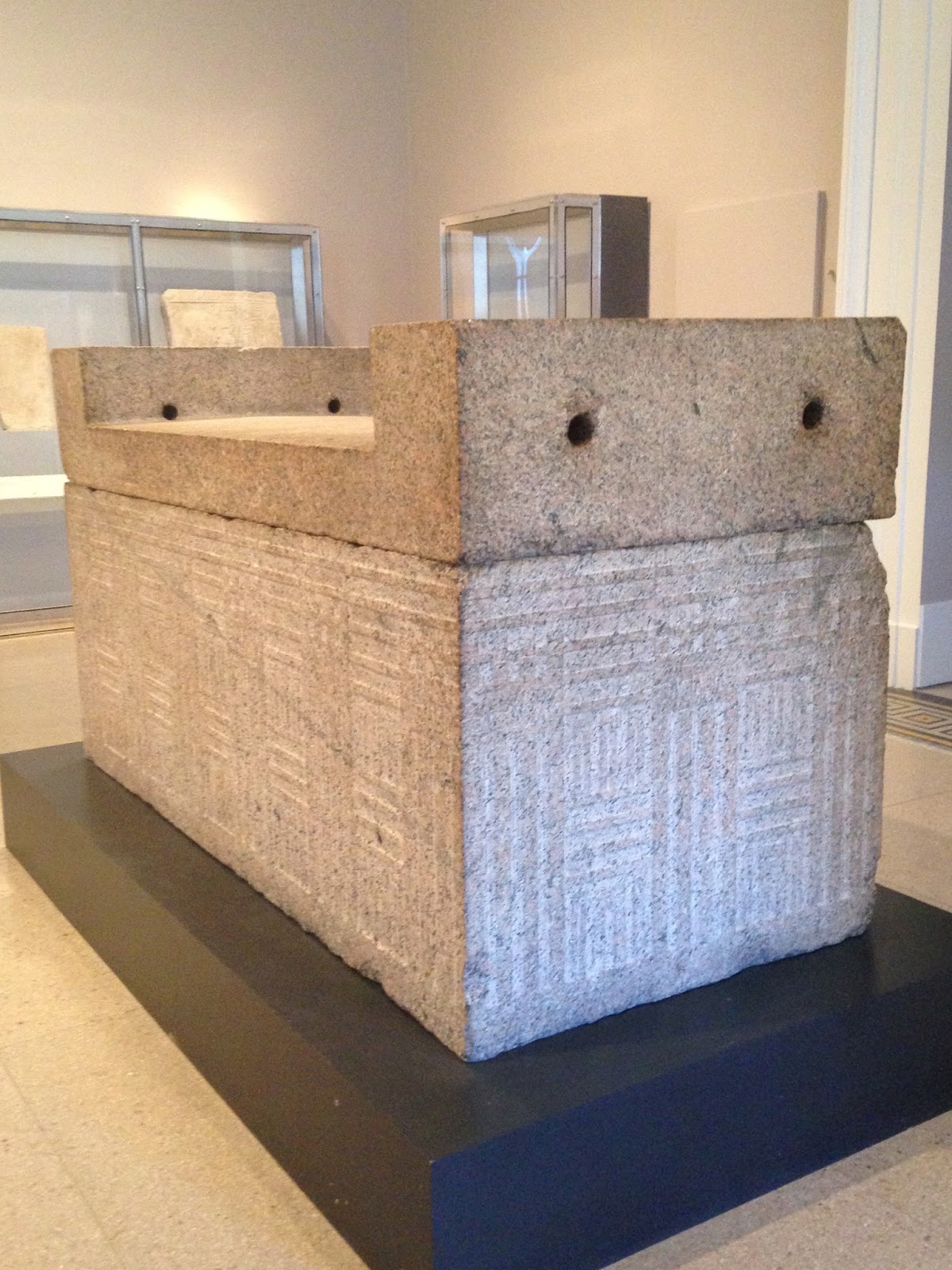
An Old Kingdom Sarcophagus

     At the end of the Pre-Dynastic Period, Egypt was unified by a Pharaoh of Upper Egypt (possibly Narmer) and royalty began distinguishing themselves from the "average" Egyptian. Their mastabas tombs in the first two dynasties became larger than the burial places of the average persons, who were usually buried in simple graves with a few pots, some jewelry and, once in a while, a wooden coffin or bed (examples of both can be seen in the Old Kingdom galleries of the Metropolitan Museum). In the early third Dynasty Djoser and his architect Imhotep built a step pyramid that was, at the time, the largest stone building erected in human history.

     In the Fourth Dynasty this trend continued as Khufu, Khafra and Menkara built the great pyramids. But other members the royal family also began showing their wealth. They were often buried in large mastabas in the shadow of the king's pyramid.
   
     Pictured here is the sarcophagus of a prince or his wife which is currently in the Brooklyn Museum. It was carved from an incredibly heavy granite block and is decorated with a pattern of niches that imitate the front of a major building complex. The lid, which was carved from a separate block of granite, has four holes drilled in it to allow ropes to be used to lower the lid onto the body of the sarcophagus after the body was laid to rest in it.

Sunday, May 14, 2017

New Find in Egypt

     Unlike Iraq and Iran where archaeological excavations are currently almost non-existent, Egypt has a lot going on. A couple of the latest finds include:

1) A Greco-Roman necropolis has been found at Tuna el-Gebel- this necropolis contains the burials of numerous animal mummies (birds and baboons at least). But as excavations continued a cachette of seventeen non-royal human mummies was found. Some of the burials were in limestone sarcophagi and a couple of wooden coffins were also found.

2) The Thirteenth Dynasty Pyramid found at Dashur - some clarity is arriving as to exactly what has been found. Some thought it was the re-discovery of a pyramid that was found many years ago, but now it does seem to be a new pyramid. The original pyramid was found in 1957 and contained the remains of a canonic jar bearing the name of King Imeny-Qemaw. The new pyramid contains a fragment of a Pyramid Text for that pharaoh.  Also, a wooden canonic chest has been found bearing the name of the princess Hatshepsut who is known from two other Dynasty Thirteen objects inscribed with her name. The canpoic box was found in the pyramid's burial chamber, so this pyramid seems to have been built for Imeny-Qemaw's daughter Hatshepsut.

Saturday, April 29, 2017

An Early Pesesh-kef?

     A Pesesh-kef is an implement used during the ancient Egyptian funerary ritual known as the Opening of the Mouth. Small kits containing a Pesesh-kef and some vases used in purification rituals are known from the Old Kingdom (as early as the Fourth Dynasty).

     In the Pre-Dynastic Period, a fair number of objects that are similar to the Pesesh-kef have been found in burials. Some egyptologists call these objects "fish-tailed knives" rather than Pesesh-kefs. The exact use of this object is unclear. It does have a very fine and sharp cutting surface in the "Y" portion of the "knife".

     But what was it used to cut and is having a Y-shaped cutting edge really useful? The answer to these questions is unclear, but Ann Macy Roth has proposed an interesting theory. She says the fish-tailed knife / pesesh-kef was used to cut the umbilical cord after a child was born.

     This object was found in a Naqada 1 grave at Ma'mariya and is now in the Brooklyn Museum.

Wednesday, April 26, 2017

Pre-Dynastic Jewelry

Fig. 1 - Naqada II Necklace
     Jewelry has been used by humans since time immemorial to enhance their appearance and, in many cases, to function as amulets that magically protect the wearer. The necklaces shown here came from Pre-Dynastic burials and may have been used for either or both purposes.

     The necklace in figure 1 comes from the Naqada II Period.  The large beads at the bottom look like cowrie shells and remind me of the golden cowrie shells found on one of the girdles of Princess Sit Hathor Yunet (dating to the reign of Senwosret II in Dynasty 12).

Fig. 2 - Naqada II Necklaces
     Figure 2 shows two more necklaces, but these date to the Naqada III Period. Figure 3 is a close up of the necklace in the upper left corner of figure 2.

Fig. 3 - Close up of a necklace in fig. 2
     These objects are made of a mixture of semi-precious stones and faience, which is ground quartz, a glaze and a binder mixed together. Faience was made by the Egyptians for thousands of years as an imitation of Lapis Lazuli stone. In fact, faience became so common that when an Egyptian text referred to the actual lapis stone, the text would usually call it "real Lapis Lazuli".


Saturday, April 22, 2017

Pre-Dynastic Knives

     A number of stone knives have been found in Pre-Dynastic excavations and one of the best examples is in the Brooklyn Museum. The blade is flint, polished on one side and delicately flaked on the other to give a sharp cutting edge. The handle is made of elephant ivory and has extremely small carvings of many animals (including elephants, giraffes, lions and sheep as well as some animals that have not yet been identified to everyone's satisfaction) on it. The upraised portion of the handle is a "thumb-rest" (according to the museum's label) for a right-handed user.

     The knife dates to the Naqada III period (about 3100 B. C.) and is from Abu Zaidan, where it was found by de Morgan during the 1907 - 1908 excavation season. A similar knife, found at Abydos seems to be from a slightly earlier period (Naqada II, 3400 - 3300 B. C.).