Saturday, January 26, 2013

Rishi Coffins in the Met

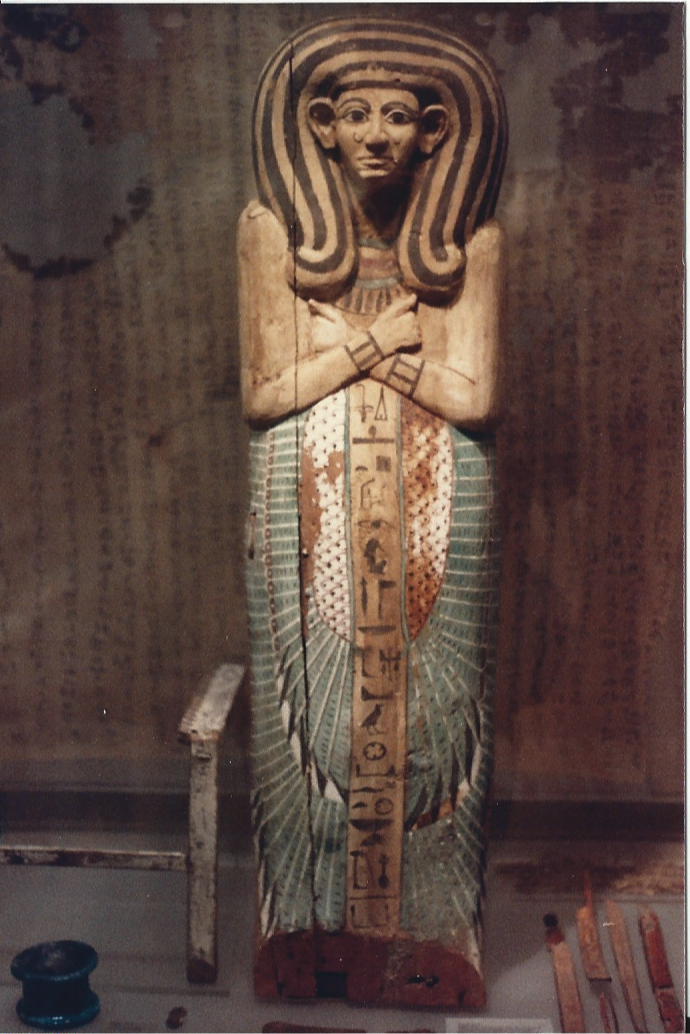
A number of rishi coffins are in the Metropolitan Museum in New York. These coffins are made of low quality wood and were made by inferior craftsmen, but they do fit to the "standard" pattern that these coffins took and can be used to illustrate our discussion.
Figure 1- 17th Dynasty rishi coffin

These coffins were anthropoid in form and the lid of the coffin is decorated with wings stretching from the chest down to the feet. Between the wings is a line of hieroglyphs called a "hotep di nisw" formula (which means, "A gift given by the king..."). This formula states that the king and one or more gods have granted offerings to the deceased and the coffin owner's name and titles are typically included in the text. However, some of these coffins were clearly stock coffins made by local undertakers and the place where the name of the deceased should have been added is sometimes left blank.

Figure 2 - Seventeenth Dynasty rishi coffin 
Often (usually?) the deceased is shown wearing a Nemes headdress which is decorated in very unusual ways. Often the lappets of the headdress are have horizontal stripes of unequal size, while the crown of the headdress is either decorated with feathers (figure 2) or with a representation of a vulture (figure 1). 

Below the lappets of the headdress the deceased is usually seen wearing a broad collar that often has a vulture and / or a cobra in the bottom center (figure 2).
Figure 3

Figure 4 - early 18th Dynasty
The decoration of these coffins is usually done by applying stucco to the coffin and then painting over the stucco. This is a lower cost way of decorating of the coffin than would be used in the 18th Dynasty.

Figure 4 is a rishi coffin that may belong to the early 18th Dynasty,  unlike the other coffins illustrated here, which almost certainly date to the 17th Dynasty. You can see differences starting to appear with the beginnings of a new, and more prosperous, era in Egyptian history. Notice that the hands of the coffin owner are shown crossed on his chest, the headdress is no longer a nemes and the workmanship is significantly better than it was in the preceding dynasty.

There are several other coffins of this type at the Met and you can see pictures of them at these links:

Friday, January 25, 2013

Rishi Coffins

I covered the topic of "Rishi" coffins in a post a while back, but I wanted to take a more detailed look at these coffins.

Rishi coffins were used from Egypt's Second Intermediate Period through the end of the Eighteenth Dynasty. The word Rishi means "feathered" in arabic; the name was given to these coffins since they all have feathered decoration on them.

Over the next couple of posts I will be looking at the Rishi coffins of the Second Intermediate Period. The Eighteenth Dynasty examples were commonly used for royal burials (see the coffins of Tutankhamen for example). The Second Intermediate Period examples are used for both royalty and for commoners.

There are two schools of thought regarding what the feathered decoration on these coffins meant. Earlier archaeologists thought that the feathers represented the outstretched wings of Isis and Nephthys as they protected the deceased. More recently, some scholars have claimed that the feathers were meant to show the deceased as a "Ba" (the human-headed bird that the Egyptians thought the soul of the deceased would take the form of).

Unlike the coffins of the Middle Kingdom, rishi coffins are anthropoid in form. These coffins are unusual not only because of the feathered decoration, but because they almost always represent the deceased wearing the "Nemes" headdress that was previously reserved for the king. More about this in the next post when we discuss the examples of these coffins in the collection of the Metropolitan Museum.


Monday, January 7, 2013

Dynasty Seventeen Canopic Chests

     Canopic chests are the stone or wooden boxes that contained the internal organs of the deceased that had been removed from their body during the mummification process. The style and decoration of canopic chests changed over the nearly three thousand years that they were in use.

     The Seventeenth Dynasty saw a new style of canopic chest come into use. The style of decoration on the chests of the period also changed. The chests were made of wood and were made in the style of contemporary rectangular coffins. The decorations were painted on over a base of plain or yellow gesso. The lids were vaulted and had raised end-pieces.

Figure 1 - Canopic Jar from tomb 55,
Eighteenth Dynasty
Figure 2 - Canopic Chest of Sekhemre
Wepmaat Intef, Dynasty 17
     Canopic chests were designed to contain canopic jars. These jars were usually made of stone and were four in number. A different protective deity was associated with each jar. Imsety was the god that protected the liver, Hapi watched over the lungs, Duamutef protected the stomach and Kebehsenuef guarded the intestines. Early jars (from the Old Kingdom) had flat, round lids. Later the lids were in the form of the four deities that protected them. At other times the lids were human headed (see figure 1 - one of the canopic jars from tomb 55 that date to the Amarna Period at the end of the Eighteenth Dynasty). The canopic chest of Sobekemsaf II (Dynasty Seventeen) was too small to have contained canopic jars. Instead, representations of the jars were painted on the jars inner lid (Dodson, Aidan. "Canopic Jars and Chests" in Redford, Donald (ed). The Oxford Encyclopedia of Ancient Egypt, Oxford: Oxford University Press, Vol. 1, 2001, p. 232).

     The canopic chests of the Seventeenth Dynasty were decorated on the sides with representations of Anubis, the god of mummification, above the signs for cloth and vegetation (see figure 2 - the canopic chest of Sekhemre Wepmaat Intef, now in the Louvre).

Friday, December 28, 2012

A Couple of Interesting Links

     I just found a couple of links that I will pass along:

     The first is a link to a site that reports on the ongoing excavations of Catal Hoyuk in Turkey (http://www.catalhoyuk.com). Catal Hoyuk is a Neolithic / Chalcolithic site in south-central Turkey that    
consists of numerous mud brick houses jammed in together. Some of the buildings have wall murals and others (religious shrines???) have several bull skulls mounted within them. Burials are sometimes found beneath the floor of the houses (an early example of a practice that is common in ancient middle eastern sites throughout ancient history).

     This site was originally excavated in the late 1950s by James Mellaart, who was later banned from excavating in Turkey on suspicion that he was involved in antiquities trafficking.

     The second link provides some information on the excavations at Hattusha (http://www.hattuscha.de/English/english1.htm) being conducted by the German Archaeological Institute. This site is also located in Turkey.

     Hattusha was the capital of the Hittite Empire that vied for power with the Assyrians and Egyptians. The excavators have reconstructed about 65 meters of the original mud brick city walls and there is some information on the reconstruction, along with some good photos, on the website.

     There is also a page on this site devoted to the nearby religious center of Yazilikaya. Included is a good description of Yazilikaya and some photos of the site's relief carvings.

     Both of these sites are well worth checking out.

Tuesday, December 25, 2012

Oxford Dictionary of Ancient Egypt

     In the reference section of a local public library I just found an interesting three volume set of books that I was not aware existed. The book is the Oxford Dictionary of Ancient Egypt. The work is edited by Donald Redford and consists of hundreds of short articles about many different topics dealing with Ancient Egypt.

     The first article I looked at was "The Opening of the Mouth", which is in volume 2. The article was written by Ann Macy Roth and describes the Opening of the Mouth Ceremony from earliest times through the Late Period. It also provides a useful bibliography.

     As time allows, I will be visiting the library to look at more articles and see what other information is contained in this work. I will also post any new information on the Opening of the Mouth that I find in this article as a supplement to the posts I did on this topic earlier this year.

Sunday, December 23, 2012

Egypt and Persia (Cont.)

     Now that the Egyptians were part of the Persian Empire, they were expected to contribute to their conquerer's military. The Egyptians helped build the bridge of boats that Xerxes used to move troops across the Hellespont and contributed 200 triremes to the Persian fleet for the invasion of Greece.

     Given the remoteness of the Persian capital, it was only a matter of time until the Egyptians began trying to throw off the Persian yoke. Eventually Dynasty 29 arose, but fighting among the Egyptians seems to have resulted in most of the Kings of this Dynasty being deposed. Eventually this Dynasty is deposed and a new family (Dynasty 30) arises to take the throne.

     The Persians were not going to let the Egyptians slip away from their control, however. in 374 B. C. Artaxerxes II attempted to regain control of Egypt. He failed.  Artaxerxes III, tried three times to re-conquer Egypt during the reign of Nectanebo II (of Dynasty 30). By 341 B.C. the Persian Empire was once again in control of Egypt. This time their rule would last until it was ended by the invasion of Alexander the Great in 332.

Tuesday, December 18, 2012

The Murder of Ramesses III

     There is news out today regarding the murder of the Twentieth Dynasty Egyptian Pharaoh Ramesses III. He is one of the few kings that we know was assassinated and doctors examining his mummy have concluded that his throat was cut. Given how deep the cut was it would seem that Ramesses did not survive the assassination attempt long enough to see the assassins executed as many have believed.

     I am not sure how far to believe this story. One problem is that no one ever noticed the cut throat before, in spite of the fact that it was apparently a cut that went almost to the spine. The second problem is that there have been so many recent "revelations" about the royal mummies that have been later questioned by experts, that one tends to be suspicious.

     In any event, here is a link to the story: http://www.iol.co.za/scitech/science/discovery/was-egypt-s-last-great-pharaoh-assassinated-1.1442172