Thursday, February 14, 2013

Rishi Coffins - a Whole Book on the Topic

During the course of researching the posts I have been doing recently on rishi coffins, I came across a book published on the topic in 2011. The book is entitled Rishi Coffins and the funerary culture of Second Intermediate Period Egypt.

The book, written by Gianluca Miniaci, grew out of the author's doctoral dissertation and contains about one hundred and fifty pages of text followed by a catalog (about one hundred and seventy pages long) of all of the rishi coffins known to the author. This volume is lavishly illustrated with line drawings and photos showing tomb plans, canopic chests and, of course, the coffins in question.

This is the only book on the topic that has been published and it is a really fine piece of scholarship. It is well written and packed with information. It has been published in a large format and is a bit heavy to carry around because it is printed on heavy, high-quality, paper.

This is definitely a specialist's book. It is not intended for lay readers, but is well enough written that an interested lay reader will have no difficulty reading it.

Sunday, February 10, 2013

Queen Meryetamun

Meryetamun was an Egyptian Queen of the early Eighteenth Dynasty. It is not clear which Pharaoh she was married to. Herbert Winlock, who found her tomb in 1929, suggested that she was married to Amenhotep II.

The Queen's coffins were made in the rishi style that was used for royalty throughout the Seventeenth and Eighteenth Dynasties.

The first of her coffins had originally been covered with sheet gold that was removed either by tomb robbers or by the officials who restored the tomb in the Twenty-First Dynasty. The original decoration seems to have consisted of two wings wrapped around the deceased and crossing at about the knee level of the coffin. Earlier rishi coffins had the wings running along the sides of the lid with an inscription running down from the waist area to the feet, but this coffin does not seem to have had an inscription on it. Above the wings of Meryetamun's coffin was a pattern of small feathers that were "covered" by a broad collar worn around the queen's neck.

The second of Meryetamun's coffins was immense, being over nine feet in length. The arm and breast area of the coffin have numerous carved depressions that contain small amounts of plaster that would have held inlaid "glass" decoration. From the arms down to the feet the coffin seems to have been covered with gold that was decorated with a father-work pattern

The Queen seems to have had a third coffin, even larger than the second one, but only fragments of it survived the attentions of the ancient tomb robbers.


Source: Winlock, Herbert. The Tomb of Queen Meryet-Amun at Thebes, New York: Arno Press, 1973 (a reprint of the original volume published in 1932).    

Thursday, February 7, 2013

New Finds in the Sudan

I saw an article about some interesting finds in the Sudan and thought I would pass it along to everyone.

At a site called Sedeinga, a huge number of pyramids were built. Inside the pyramids are circular constructions that, according to the archaeologists, add nothing to the stability of the pyramid. So why are these circular structures there? One possibility is that the circular structures are a "nod" to the tumuli that were used in earlier times for burials in the region, while the pyramid was a conscious imitation of ancient Egyptian pyramids.

Here is a link to the article:

http://www.foxnews.com/science/2013/02/07/35-ancient-pyramids-discovered-in-sudan/?intcmp=features

Saturday, February 2, 2013

Rishi Coffins in the British Museum

Fig. 1 - Seventeenth Dynasty Rishi Coffin
Figure 2 - Dynasty 17 / Dynasty 18 rishi coffin
There are a number of Second Intermediate Period rishi Coffins in the British Museum, including that of Nekheperre Intef, a Pharaoh of the Seventeenth Dynasty.

Figure 1 is a wood coffin covered with gesso and then painted. It is fairly typical of the period, with painted wings extending from the chest down to the feet on either side of a central inscription. The deceased is shown wearing a broad collar on the their chest and the nemes headdress is feathered at the top and decorated with stripes on the lappets. The arms of the deceased are not shown crossed on the chest.

Figure 3 - the coffin of Nebkheperre Intef, Dynasty 17
Figure 2 shows the coffin of another private person. It is possibly from the early Eighteenth Dynasty as the artwork is better and the style seems to fit with a slightly later date than the coffin in figure 1.  The headdress is not a names and the feather-work on the lid is limited to the wings that extend down from the chest area. The usual inscription appears between the wings and a broad collar and vulture necklace adorn the lid's chest area.

The third coffin is that of the Seventeenth Dynasty Pharaoh Nebkheperre Intef. The coffin is made of wood covered with a thin layer of gold. The nemes headdress is the standard one worn by the king since the Old Kingdom and includes a uraeus on its brow.


Nebkheperre’s burial was found at Dra abu Naga in 1827 by local tomb robbers. Inside this coffin were two bows and six arrowsa diadem and a mummy from a later period that was almost certainly placed there by the tomb robbers in an attempt to increase the value of their discovery.

In the next post I will take a look at the Eighteenth Dynasty burial of  Queen Meryt-Amun which also contained some rishi coffins.


Saturday, January 26, 2013

Rishi Coffins in the Met

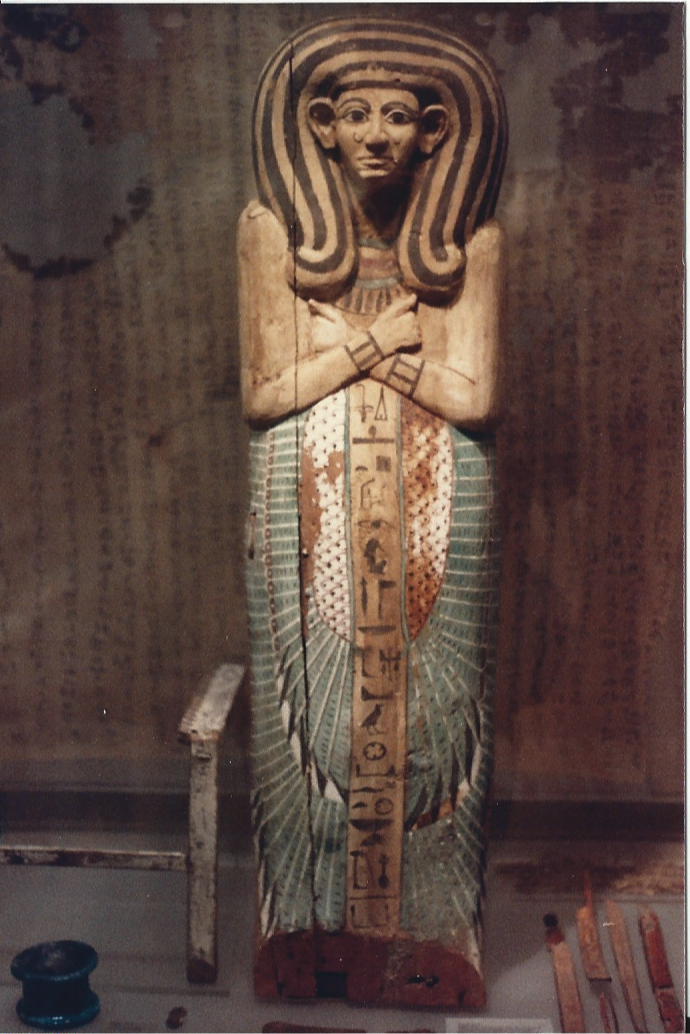
A number of rishi coffins are in the Metropolitan Museum in New York. These coffins are made of low quality wood and were made by inferior craftsmen, but they do fit to the "standard" pattern that these coffins took and can be used to illustrate our discussion.
Figure 1- 17th Dynasty rishi coffin

These coffins were anthropoid in form and the lid of the coffin is decorated with wings stretching from the chest down to the feet. Between the wings is a line of hieroglyphs called a "hotep di nisw" formula (which means, "A gift given by the king..."). This formula states that the king and one or more gods have granted offerings to the deceased and the coffin owner's name and titles are typically included in the text. However, some of these coffins were clearly stock coffins made by local undertakers and the place where the name of the deceased should have been added is sometimes left blank.

Figure 2 - Seventeenth Dynasty rishi coffin 
Often (usually?) the deceased is shown wearing a Nemes headdress which is decorated in very unusual ways. Often the lappets of the headdress are have horizontal stripes of unequal size, while the crown of the headdress is either decorated with feathers (figure 2) or with a representation of a vulture (figure 1). 

Below the lappets of the headdress the deceased is usually seen wearing a broad collar that often has a vulture and / or a cobra in the bottom center (figure 2).
Figure 3

Figure 4 - early 18th Dynasty
The decoration of these coffins is usually done by applying stucco to the coffin and then painting over the stucco. This is a lower cost way of decorating of the coffin than would be used in the 18th Dynasty.

Figure 4 is a rishi coffin that may belong to the early 18th Dynasty,  unlike the other coffins illustrated here, which almost certainly date to the 17th Dynasty. You can see differences starting to appear with the beginnings of a new, and more prosperous, era in Egyptian history. Notice that the hands of the coffin owner are shown crossed on his chest, the headdress is no longer a nemes and the workmanship is significantly better than it was in the preceding dynasty.

There are several other coffins of this type at the Met and you can see pictures of them at these links:

Friday, January 25, 2013

Rishi Coffins

I covered the topic of "Rishi" coffins in a post a while back, but I wanted to take a more detailed look at these coffins.

Rishi coffins were used from Egypt's Second Intermediate Period through the end of the Eighteenth Dynasty. The word Rishi means "feathered" in arabic; the name was given to these coffins since they all have feathered decoration on them.

Over the next couple of posts I will be looking at the Rishi coffins of the Second Intermediate Period. The Eighteenth Dynasty examples were commonly used for royal burials (see the coffins of Tutankhamen for example). The Second Intermediate Period examples are used for both royalty and for commoners.

There are two schools of thought regarding what the feathered decoration on these coffins meant. Earlier archaeologists thought that the feathers represented the outstretched wings of Isis and Nephthys as they protected the deceased. More recently, some scholars have claimed that the feathers were meant to show the deceased as a "Ba" (the human-headed bird that the Egyptians thought the soul of the deceased would take the form of).

Unlike the coffins of the Middle Kingdom, rishi coffins are anthropoid in form. These coffins are unusual not only because of the feathered decoration, but because they almost always represent the deceased wearing the "Nemes" headdress that was previously reserved for the king. More about this in the next post when we discuss the examples of these coffins in the collection of the Metropolitan Museum.


Monday, January 7, 2013

Dynasty Seventeen Canopic Chests

     Canopic chests are the stone or wooden boxes that contained the internal organs of the deceased that had been removed from their body during the mummification process. The style and decoration of canopic chests changed over the nearly three thousand years that they were in use.

     The Seventeenth Dynasty saw a new style of canopic chest come into use. The style of decoration on the chests of the period also changed. The chests were made of wood and were made in the style of contemporary rectangular coffins. The decorations were painted on over a base of plain or yellow gesso. The lids were vaulted and had raised end-pieces.

Figure 1 - Canopic Jar from tomb 55,
Eighteenth Dynasty
Figure 2 - Canopic Chest of Sekhemre
Wepmaat Intef, Dynasty 17
     Canopic chests were designed to contain canopic jars. These jars were usually made of stone and were four in number. A different protective deity was associated with each jar. Imsety was the god that protected the liver, Hapi watched over the lungs, Duamutef protected the stomach and Kebehsenuef guarded the intestines. Early jars (from the Old Kingdom) had flat, round lids. Later the lids were in the form of the four deities that protected them. At other times the lids were human headed (see figure 1 - one of the canopic jars from tomb 55 that date to the Amarna Period at the end of the Eighteenth Dynasty). The canopic chest of Sobekemsaf II (Dynasty Seventeen) was too small to have contained canopic jars. Instead, representations of the jars were painted on the jars inner lid (Dodson, Aidan. "Canopic Jars and Chests" in Redford, Donald (ed). The Oxford Encyclopedia of Ancient Egypt, Oxford: Oxford University Press, Vol. 1, 2001, p. 232).

     The canopic chests of the Seventeenth Dynasty were decorated on the sides with representations of Anubis, the god of mummification, above the signs for cloth and vegetation (see figure 2 - the canopic chest of Sekhemre Wepmaat Intef, now in the Louvre).